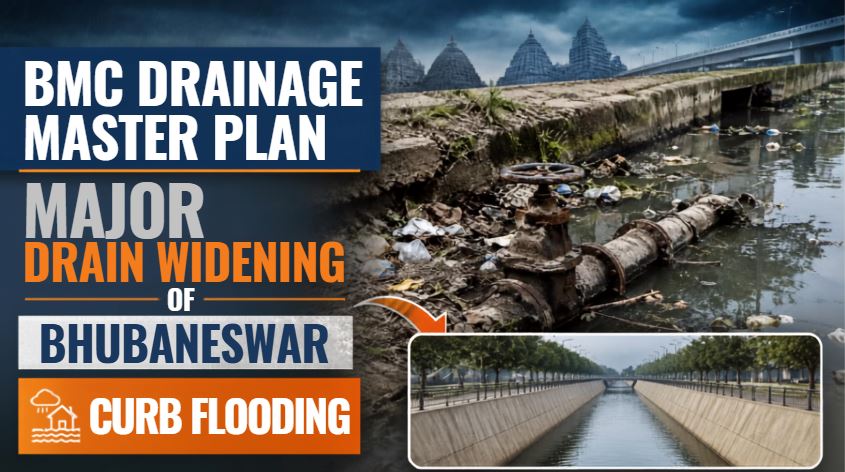
Bhubaneswar, Sept. 16 (UDN): Major drainage channels in Bhubaneswar could be widened to as much as 40 metres under a proposed comprehensive drainage master plan aimed at improving the city’s rainwater-carrying capacity and reducing recurring waterlogging and urban flooding.
Representational Image
The draft plan, prepared for the Bhubaneswar Municipal Corporation (BMC), was unveiled at a civic body meeting. City Engineer Prafulla Raito said the plan was prepared by IIT-Roorkee under an MoU signed with the civic body in February 2025.
The proposed blueprint covers nearly 256 sq km under the BMC jurisdiction and seeks to establish an integrated drainage network designed to address both present and future urban water-management challenges.
Major drains proposed for widening
Bhubaneswar currently has 11 major rainwater channels, supported by a network of secondary and tertiary drains. The draft recommends widening several major drains whose existing widths range from 3 to 9 metres, with some proposed to be expanded up to 40 metres.
The objective is to increase the volume of stormwater that can be safely carried through the city’s drainage system, particularly during periods of intense rainfall.
Rather than treating individual drains as separate projects, the master plan considers Bhubaneswar as a single urban watershed. It proposes coordinated measures covering drainage channels, water bodies, outfalls and other components of the stormwater network.
Focus on technology and natural drainage
The plan also calls for protecting existing water bodies and natural drainage corridors while strengthening groundwater recharge measures.
Technology-based interventions, including SCADA monitoring, water-level sensors, flood alarms and early-warning systems, have been proposed to help authorities monitor the drainage network and respond to flooding more quickly.
The assessment covers primary, secondary and tertiary drains, along with water bodies, culverts, syphons and outfalls. Flood-prone locations and bottlenecks have also been identified as part of the study.
The plan reportedly takes into account projected population growth, continued urbanisation and anticipated hydro-climatic conditions through 2050.
Daya-Gangua system under assessment
The Daya River and the Gangua nullah outfall system have been examined in terms of their carrying capacity, slope, hydraulic conditions and downstream limitations.
However, implementing some of the proposed drainage interventions could require substantial land acquisition, according to BMC officials. Raito said IIT-Roorkee would also explore feasible alternatives wherever acquisition poses challenges.
Meanwhile, the BMC has sought Rs 200 crore from the National Disaster Management Authority (NDMA) for strengthening Bhubaneswar’s drainage infrastructure.
The proposed master plan is expected to provide a long-term framework for upgrading the city’s stormwater network as Bhubaneswar continues to expand and faces increasing pressure from intense rainfall and rapid urbanisation.