Hyderabad, Sep 04: A 30-year-old man who had been advised a liver transplant after suffering from severe and recurrent accumulation of fluid in the abdomen for nearly a year has avoided major transplant surgery following the correct diagnosis and minimally invasive treatment at KIMS Hospitals, Kondapur.
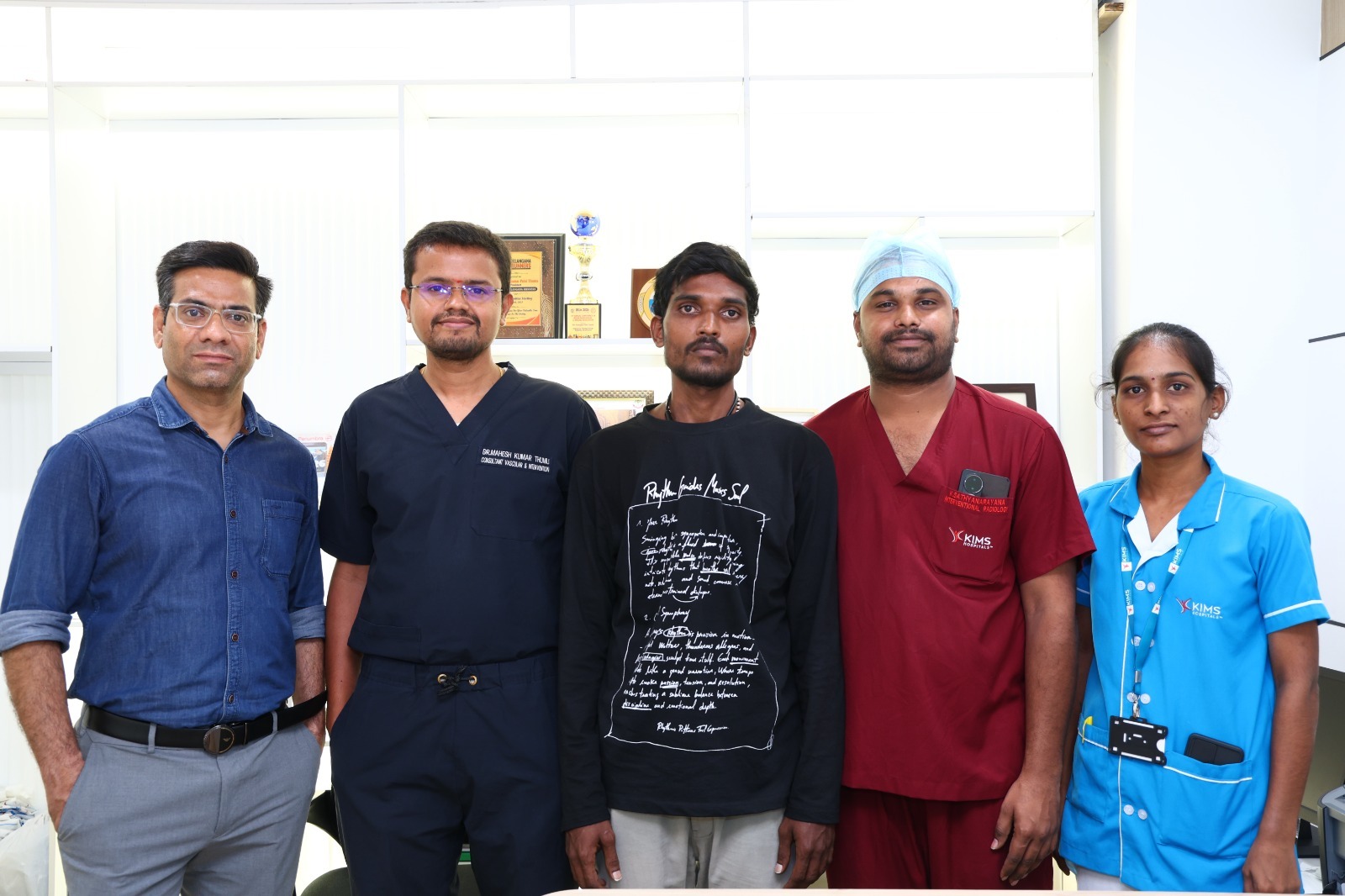
The patient from vizag, who had been consulting doctors for recurrent abdominal fluid accumulation, was initially suspected to have advanced liver disease, with his history of alcohol consumption being considered a possible cause. He was advised to undergo a liver transplant. Seeking a second opinion, he approached KIMS Hospitals, Kondapur, where a multidisciplinary team of interventional radiologists and medical gastroenterologists conducted a detailed evaluation.
Investigations, including advanced vascular imaging, revealed that the underlying problem was not conventional alcohol-related liver disease but chronic Budd-Chiari syndrome, a rare vascular disorder in which the veins draining blood from the liver become severely narrowed or blocked.
The evaluation showed severe narrowing and complete occlusion of the major hepatic veins, resulting in obstruction to the normal outflow of blood from the liver. This impaired hepatic venous drainage and led to repeated accumulation of fluid in the abdomen, a condition known as ascites. A blood clot was also detected in an accessory left hepatic vein, which was providing an alternative route for hepatic venous drainage.
Considering the patient’s young age and the underlying vascular cause, the KIMS team decided to explore restoration of hepatic blood flow rather than proceeding directly to liver transplantation. Since the major hepatic veins were completely occluded, the interventional radiology team accessed the partially patent accessory hepatic vein through a specialised minimally invasive approach.
A balloon venoplasty was first performed to widen the narrowed venous segment, followed by placement of a metallic stent to maintain the restored blood-flow pathway. The procedure successfully re-established venous drainage from the liver without the need for major surgery.
Following the procedure, the patient recovered well and was discharged on medication under medical supervision. At a follow-up examination one month later, the recurrent abdominal fluid accumulation had resolved completely. Liver function tests also showed significant improvement.
Dr. Mahesh Kumar Thummu, Interventional Radiologist, KIMS Hospitals, Kondapur, who was part of the treating team, said that Budd-Chiari syndrome can sometimes be difficult to identify because its clinical presentation may resemble that of common forms of liver cirrhosis.
“Recurrent ascites in a young person, particularly when it does not respond adequately to conventional treatment, should prompt evaluation of the hepatic venous outflow tract and not be attributed solely to routine liver disease. In this case, detailed vascular imaging helped us identify the underlying cause. By restoring hepatic venous drainage through a minimally invasive intervention, we were able to improve the patient’s liver blood flow and avoid proceeding directly to transplantation,” he said.
He emphasised that seeking a timely second opinion and undertaking appropriate advanced imaging can help identify potentially treatable vascular causes in patients who are otherwise being considered for major procedures such as liver transplantation.
What is Budd-Chiari syndrome?
Budd-Chiari syndrome is a rare disorder caused by obstruction or severe narrowing of the hepatic veins or the major venous pathways that carry blood away from the liver. The obstruction causes blood to accumulate within the liver, leading to increased pressure in the portal venous system, abdominal fluid accumulation and progressive impairment of liver function.
In severe cases, the condition can progress to liver failure and may require liver transplantation. However, depending on the site and extent of venous obstruction, treatments aimed at restoring blood flow—including angioplasty, venous stenting and other interventional procedures—may provide an alternative to transplantation in appropriately selected patients.
KIMS doctors advised that Budd-Chiari syndrome should be considered, particularly in younger patients presenting with recurrent or unexplained ascites, liver-related symptoms without a clear cause, or poor response to conventional treatment. Early diagnosis and appropriate vascular evaluation can help identify patients who may benefit from minimally invasive treatment.