India, Sep 03: As artificial intelligence moves rapidly from experimentation to practical applications across healthcare, the next critical question for hospitals is not simply how to adopt AI, but how to ensure that it contributes to safer clinical decisions and better patient outcomes.
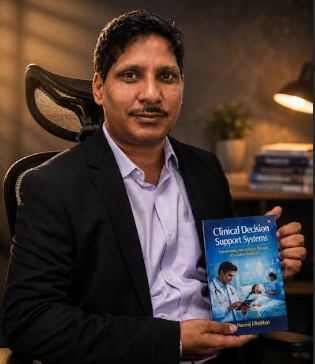
Leading healthcare experts came together today for a panel discussion on “Patient Safety in the Age of AI: Are Indian Hospitals Ready for Intelligent Clinical Decision Support?” to examine the opportunities, risks and readiness of Indian hospitals as AI increasingly influences clinical and healthcare decision-making.
The panel featured Dr. Neeraj Dhabhai, Author and VP, Supply Chain, Rainbow Children’s Hospital, Dr. A.Ramkishan, Deputy Drugs Controller and DGHS, Ministry of Health and Family Welfare , Dr. N. Venkatesan, Sr. Director & Chief Procurement Officer, Max Healthcare and Mr. Arvind Sivaramakrishnan, Group CTO, Asia Healthcare Holdings. The discussion was moderated by Dr. Vikram Venkateswaran, Founder, Healthcare India and Medbyte.
The panel examined how hospitals can move beyond simply accumulating and digitising data to ensuring that the right information reaches the right healthcare professional at the right time. It explored the potential for AI-enabled decision support to bring together fragmented information, identify clinically relevant patterns, provide timely alerts and support evidence-based decision-making, while retaining the clinician at the centre of care.
The discussion also highlighted that AI adoption cannot be separated from questions of data quality, interoperability, workflow integration, governance, cybersecurity, clinical validation and organisational readiness. An earlier EY-Parthenon-CII study on Generative AI in Indian healthcare found that while more than 60% of healthcare CIOs were keen to introduce GenAI within six to 12 months, 80% said their organisations were not yet fully ready, citing concerns including data privacy, cybersecurity and biased responses.
Launch of Clinical Decision Support Systems: Transforming Patient Safety Through AI in Indian Healthcare
The discussion marked the launch of Dr. Neeraj Dhabhai’s new book, Clinical Decision Support Systems: Transforming Patient Safety Through AI in Indian Healthcare, which provides a focused examination of how AI and clinical decision support can help address some of the critical challenges confronting healthcare today.
At the heart of the book is a fundamental question: if the information required to prevent patient harm already exists somewhere within the healthcare system, why does it so often fail to reach the right person at the right time?
Drawing on nearly two decades of experience across hospital operations, healthcare supply chains, technology-led transformation, and healthcare innovation, Dr Dhabhai examines the transition from fragmented information systems to more intelligent, timely and evidence-based clinical decision-making.
The book explores the technology architecture and practical applications of CDSS, its potential across hospital departments and workflows, and how intelligent decision support can contribute to patient safety, medication safety, evidence-based prescribing and potentially life-saving interventions. It also examines the implementation challenges specific to Indian healthcare and the need for a structured roadmap that combines technology with clinical processes, governance and stakeholder adoption.
Dr. Dhabhai’s central proposition is that the next phase of healthcare transformation should go beyond digitising or automating processes. The opportunity lies in using data intelligently to support better decisions and better patient outcomes, while ensuring that AI augments rather than replaces clinical judgement.
“AI’s value in healthcare will ultimately be determined not by how much technology we deploy, but by whether it helps healthcare professionals make better and safer decisions at the point of care. Clinical decision support provides an opportunity to connect fragmented information with clinical context, while keeping patient safety and professional judgement at the centre,” said Dr. Neeraj Dhabhai.
“The discussion and the book together underline a larger imperative for the industry: as AI becomes increasingly embedded in healthcare, patient safety must be designed into the architecture, workflows and implementation strategy, not added as an afterthought”, Dr Dhabhai added.
Dr. A. Ramkishan, Deputy Drugs Controller and Ministry of Health and Family Welfare, Govt.of India
“Patient safety must remain the foundation as healthcare embraces Artificial Intelligence. The potential of AI and Clinical Decision Support Systems is significant, particularly in helping healthcare professionals access relevant information, identify risks and support more informed decisions. However, technology-driven healthcare must evolve alongside appropriate standards for quality, validation, accountability, data integrity and clinical oversight. For India, the opportunity is to create an ecosystem where innovation and patient safety advance together. The focus should therefore be not only on adopting AI, but on ensuring that these technologies are reliable, transparent, evidence-based and integrated responsibly into healthcare systems.”
Aravind Sivaramakrishnan, Group CTO, Asia Healthcare Holdings
“The real opportunity with AI in healthcare is not simply to automate more processes, but to create an intelligent layer that can bring together fragmented information and support clinicians at the point of decision-making. For Clinical Decision Support Systems to genuinely improve patient safety, however, AI cannot operate in isolation. It needs to be built on strong digital foundations, interoperable systems, reliable data, robust cybersecurity and workflows designed around the way clinicians actually work. As Indian healthcare moves from digital adoption to intelligent healthcare, the focus must be on deploying AI responsibly, with clinical oversight and measurable outcomes. The goal should ultimately be simple: use technology to help healthcare professionals make better, faster and safer decisions for patients.”
Dr. N Venkatesan, Sr. Director & Chief Procurement Officer, Max Healthcare
“Clinical Decision Support Systems have the potential to fundamentally transform healthcare by bringing the power of AI, data and evidence closer to every clinical decision. In India, the real opportunity is to use AI-enabled decision support not to replace the clinician, but to augment clinical judgement, reduce variability, improve patient safety and enable better outcomes at scale.”
Dr. Vikram Venkateswaran, Founder, Healthcare India and Medbyte
“An average patient generates 80 MB of data per year. All this data is captured electronically. There is a need for a technology enabled intelligence layer that looks at insights from the data not only to promote clinical outcomes but also enhance patient safety. Clinical Decision Support System is that layer can help translate that data into insights that create better decisions for the physicians and clinical outcomes for the patients”