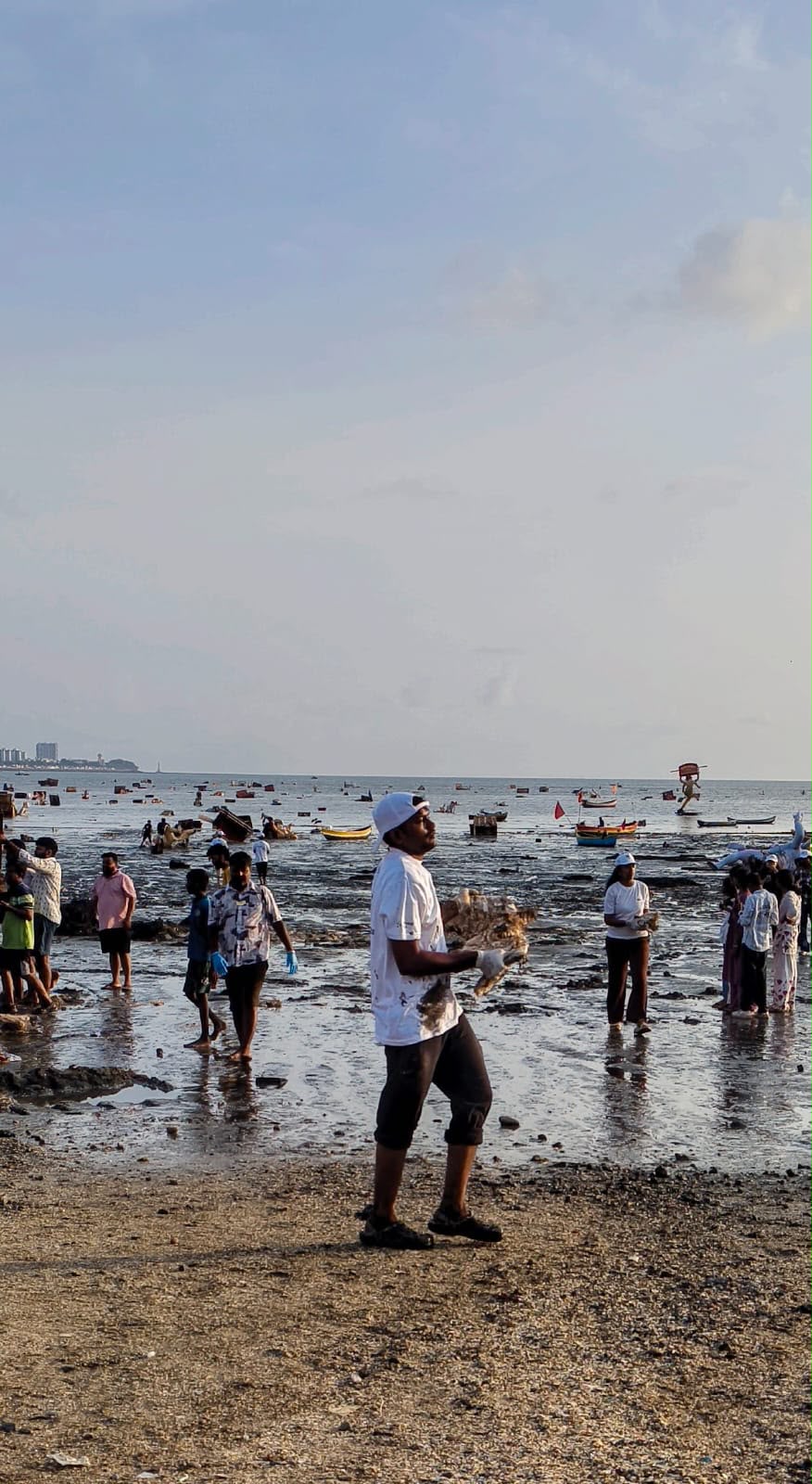
Mumbai, 28 September 2026: The morning after Anant Chaturdashi, when the crowds had dispersed and the celebrations had moved on, more than 4,000 volunteers came together at Mumbai’s Girgaon Chowpatty to address what the tide and festivities had left behind.
Led by Change Is Us, in collaboration with The New India Assurance Co. Ltd. India’s largest General Insurance Company, and Nature and Thought, the two-hour post-visarjan clean-up on Saturday, 26 September resulted in 40,000 kg of festive remnants being diverted from the shoreline. The clean-up ran from 4 p.m. to 6 p.m., with 50 volunteers manning and coordinating the clean-up operations on the ground.
The effort was designed to complement, rather than replace, the city’s civic clean-up operations. It brought together citizens at one of Mumbai’s most iconic beaches at the point when the environmental aftermath of Ganeshotsav was most visible, turning participation into a direct, measurable intervention.
The material collected included flowers and garlands, cloth, coconuts, puja material, plastic packaging, thermocol, decorative material and fragments from idols and decorations. Teams worked across the designated Chowpatty stretch, collecting and segregating material at source, with organic offerings separated for appropriate processing rather than being mixed with general waste.
The scale of this year’s effort also reflects the growing momentum behind citizen participation. In 2024, 3,000 volunteers helped collect approximately 40,000 kg of festive remnants. In 2025, participation increased to 3,500 volunteers, with 42,000 kg collected. In 2026, the initiative mobilised 4,000 volunteers and diverted another 40,000 kg of festive remnants.
Across the three-year period, the initiative has therefore mobilised more than 10,500 volunteer participants and diverted more than 1.22 lakh kg of festive remnants, demonstrating how a concentrated citizen effort can create a measurable response to the environmental footprint of one of Mumbai’s largest festivals.
From celebration to responsibility, Mumbai’s civic infrastructure has expanded significantly to manage the environmental impact of Ganesh visarjan. This year, the city had 288 artificial ponds, alongside 44 designated beaches and jetties and 23 natural lakes, taking the total number of immersion locations to 348.
The BMC also provided idol-makers with 858 tonnes of clay and more than 25,000 litres of eco-friendly paint free of cost, while deploying close to 500 nirmalya collection bins and more than 300 nirmalya dumpers to facilitate the segregation and collection of flowers and other organic offerings during the festival.
These measures form an important part of Mumbai’s broader effort to manage the scale of Ganeshotsav. But the experience at Girgaon Chowpatty underlines another reality: even with citywide systems in place, individual public spaces can require concentrated attention once the crowds have left.
“The day after visarjan is when the celebration leaves the city with a very different kind of responsibility,” said Shubh Mehta, Co-Founder, Change Is Us. “We are not here to point fingers or replace the work already being done. We are here because we believe citizens can, and should, take responsibility for the spaces they celebrate in. If thousands of people can come together to celebrate, thousands can also come together to clean up. What matters is turning that sentiment into action, and making the action measurable.”
For Change Is Us, the growing participation over the past three years points to a broader shift in how citizens can engage with Mumbai’s public spaces. What began with 3,000 volunteers in 2024 has grown to 4,000 volunteers in 2026, with more than 1.22 lakh kg of festive remnants diverted across the three editions.