Bhubaneswar, Dec 15: APICOL, in association with ASSOCHAM, successfully hosted the Cold Storage Conclave & Buyer Seller Meet 2025 at Welcomhotel by ITC, Bhubaneswar, bringing together policymakers, industry leaders, agri-entrepreneurs, farmer groups, financial institutions, and technology providers to accelerate the growth of Odisha’s cold storage and post-harvest infrastructure.
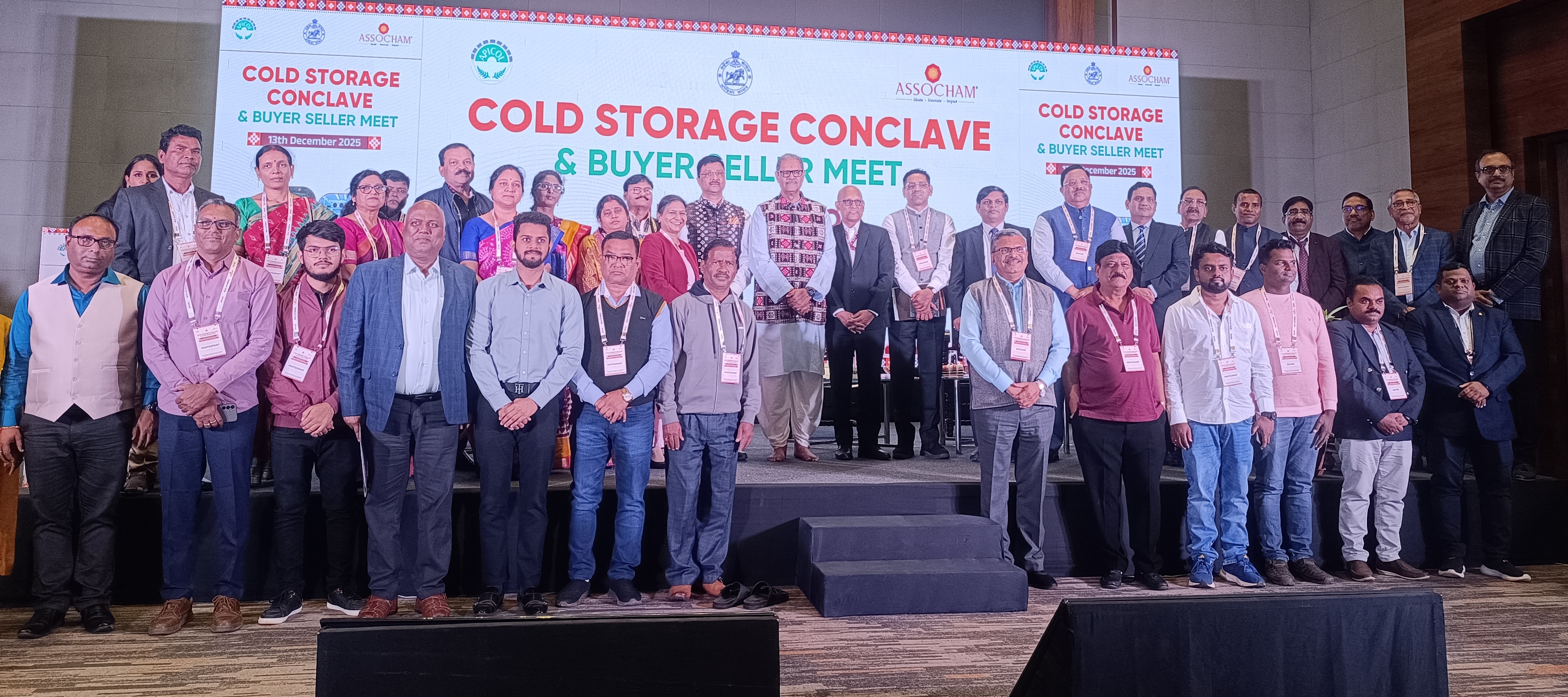
The event was inaugurated by Shri Kanak Vardhan Singh Deo, Deputy Chief Minister and Minister of Agriculture and Farmers’ Empowerment, who formally opened the exhibition and visited various stalls showcasing Odisha’s agri-horti potential. During the inaugural session, approval letters were distributed to cold storage beneficiaries.
Addressing the gathering, Shri Kanak Vardhan Singh Deo stated, “The state government is committed to creating an enabling ecosystem for investment, innovation, and inclusive growth in agriculture and allied sectors. Emphasising sustainability, we aim to establish cold storage units in 58 sub-divisions by FY 2029–30, with a proposed budget outlay of INR 252 crore.”
He highlighted key policy interventions such as capital investment subsidies and interest reimbursement to revitalise defunct cold storage units and ensure the long-term viability of new projects. He urged banks, industry associations, technology providers, and large buyers to collaborate closely with Odisha’s farmers and entrepreneurs, noting that strong value-chain partnerships are essential to unlock the sector’s full potential.
Dr. Arabinda Kumar Padhee, IAS, Principal Secretary, Department of Agriculture and Farmers’ Empowerment, highlighted Odisha’s transition towards market-led agriculture. He noted that the state has been rice-surplus for the past 16–17 years, supplying over 12 states, and produced nearly 15 million tonnes of food grains along with an equal volume of horticultural produce in the last agricultural year. Dr. Padhee emphasised the government’s concise yet comprehensive cold storage policy with attractive incentives to strengthen the ecosystem and attract private investment, highlighting that over 15 proposals have already been received from investors setting up units.
Shri Kalunge Gorakh Waman, IFS, Director of Horticulture, Government of Odisha, explained that the horticulture sector is entering a pivotal phase through the visionary Cold Storage Policy, which aims to strengthen post-harvest management by building a reliable cold storage and logistics network. The Horticulture Directorate, in collaboration with APICOL, is operationalising support mechanisms including capital assistance, time-bound completion of new units, and electricity tariff subsidies to ensure viable operations.
From the industry perspective, Dr. Prabodh Mohanty, Chairman, ASSOCHAM Odisha (Mining, Steel, and Agri Council) and MD, SNM Group, emphasised that Odisha’s next growth leap depends on modernising post-harvest logistics and processing. He highlighted the importance of integrated cold storage solutions with pre-cooling, digital quality tracking, grading, sorting, and access to organised buyers, noting that market predictability and long-term procurement commitments are key to attracting private capital.
Shubhranshu Mishra, Managing Director, APICOL, reaffirmed the government’s vision for a robust and sustainable cold storage ecosystem. He highlighted new schemes under the Agriculture and Farmers’ Empowerment Department aimed at reviving defunct units, ensuring sustainability beyond the scheme period, reducing post-harvest losses, and enhancing farmers’ incomes.
The event also featured panel discussions on scaling supply chains in Odisha, market access, branding and financing rural enterprises, and developing Odisha’s cold chain and market linkages. The Buyer–Seller Meet emerged as a major highlight, connecting producers, FPOs, SHGs, and entrepreneurs with national buyers from retail, export, and e-commerce sectors. A parallel exhibition showcased a diverse range of local and value-added products, including GI-tagged cashews, honey, spices, mushrooms, and exotic vegetables, facilitating direct business interactions and trade opportunities.
Experts from organisations such as APEDA, NABARD, DANFOS, and leading technology firms shared insights on strengthening cold chains, reducing food waste, improving market access, and integrating Odisha’s agri-enterprises with organised domestic and export value chains.
The conclave concluded with a vote of thanks by Mrs. Geetashree Parhi, Additional Director, Directorate of Horticulture, reaffirming the collective commitment of the government and industry to build a resilient, market-linked, and investment-friendly agri-horti ecosystem in Odisha.