New Delhi, Nov 4: In a major push towards self-reliance in strategic mineral resources, the Union Cabinet on Wednesday approved a Rs 2,814-crore capital support scheme to strengthen India’s domestic critical mineral processing industry and reduce dependence on imports.
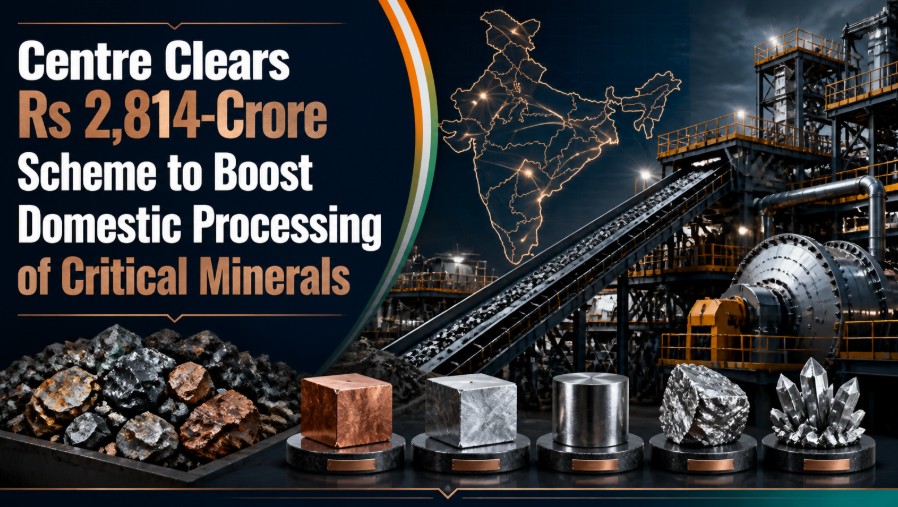
Representational Image
The scheme, titled ‘Capex Support Scheme to Promote Critical Mineral Processing’, was approved at a Cabinet meeting chaired by Prime Minister Narendra Modi. It will be implemented over five years, from FY 2026-27 to 2030-31.
The initiative aims to establish a strong domestic processing ecosystem for critical minerals such as lithium and nickel, which are essential for electric vehicle batteries, renewable energy storage, electronics, defence equipment and other strategic industries.
Four processing plants to be established
Under the scheme, the government plans to support the establishment of four critical mineral processing facilities across the country.
These will include:
Two lithium processing plants, each with a minimum capacity of 30,000 tonnes.
Two nickel processing plants, each with a minimum capacity of 50,000 tonnes.
The facilities will process lithium and nickel ores or intermediate products into high-purity compounds. Cobalt is also expected to be recovered as a by-product of nickel processing.
The government will provide capital subsidies covering 30 per cent of eligible investments to encourage companies to establish these facilities.
Financial assistance for selected companies
The Rs 2,814-crore financial allocation will support eligible investments through a structured incentive mechanism.
The maximum capital assistance will be capped at Rs 500 crore for each selected lithium processing beneficiary and Rs 900 crore for each nickel processing beneficiary.
Beneficiaries will be selected through a two-stage competitive process. Applicants will first undergo technical evaluation, with only those meeting the prescribed eligibility requirements qualifying for financial bidding.
For each mineral category, two companies will be selected based on the least-cost principle, giving preference to bidders seeking the lowest capital expenditure support from the government.
The approved incentives will be released in three instalments linked to the achievement of specified project milestones.
Reducing dependence on imported minerals
India currently relies heavily on imports for refined critical mineral products and high-purity materials, as domestic processing infrastructure remains at an early stage.
The concentration of critical mineral processing facilities in a limited number of countries has exposed global supply chains to geopolitical tensions, price fluctuations and possible export restrictions.
Establishing domestic processing capabilities is therefore considered important for strengthening India’s economic security and ensuring a stable supply of materials for strategic industries.
The government has identified high capital requirements, limited access to advanced processing technologies and difficulties in securing raw materials as major obstacles to the development of commercial-scale domestic facilities.
The new scheme seeks to address these challenges by providing targeted financial assistance and encouraging private sector investment.
Boost for EV batteries, defence and clean energy
Critical minerals play an increasingly important role in India’s industrial and energy transition.
Lithium and nickel are key inputs in several battery technologies, while cobalt is used in certain battery chemistries and other advanced industrial applications.
The proposed processing facilities are expected to support industries involved in electric mobility, Battery Energy Storage Systems (BESS), electronics, defence manufacturing and speciality steel.
By developing domestic processing capacity, India aims to retain a larger share of value addition within the country, strengthen industrial supply chains and reduce exposure to international market disruptions.
Push towards Atmanirbhar Bharat
The Cabinet-approved scheme is part of the government’s broader strategy to build a resilient domestic critical mineral ecosystem.
Beyond reducing import dependence, the initiative is expected to encourage technology development, attract private investment and create a stronger foundation for downstream manufacturing.
With implementation scheduled between 2026-27 and 2030-31, the scheme marks an important step towards strengthening India’s position in the global critical mineral value chain and advancing the objectives of Atmanirbhar Bharat.