Bhubaneswar, Sept. 17 (UDN): IIT Bhubaneswar and IIT (Indian School of Mines) Dhanbad have signed a five-year Memorandum of Understanding (MoU) to strengthen research, academic exchange and collaboration, with semiconductor technology and basic sciences identified as initial areas of focus.
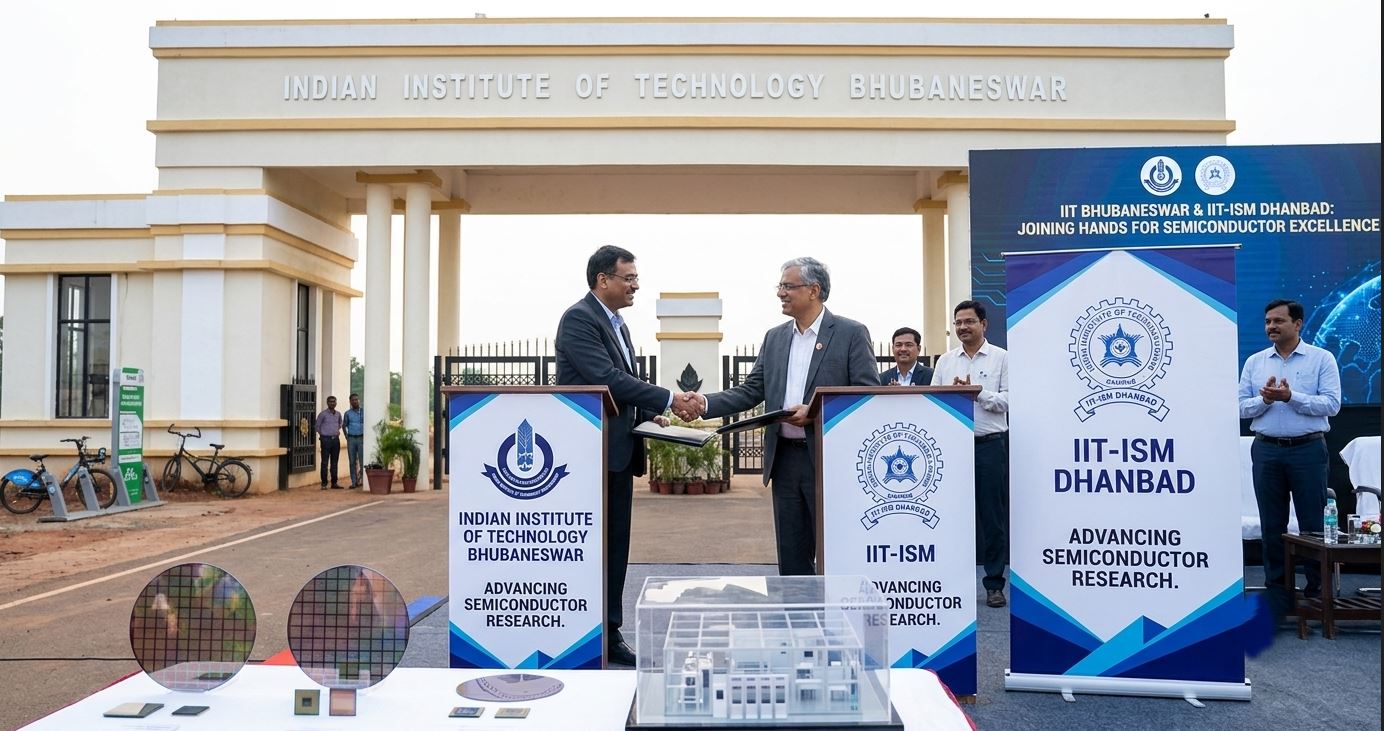
Representational Image
The agreement was signed on September 16 by IIT Bhubaneswar Director Prof. Shreepad Karmalkar and IIT (ISM) Dhanbad Director Prof. Sukumar Mishra. The partnership is designed to bring together the complementary expertise and research capabilities of the two institutions.
Joint Research, Doctoral Collaboration
Under the MoU, the institutes will undertake joint research programmes and collaborative projects, while enabling reciprocal supervision of doctoral scholars. They will also explore opportunities to jointly seek research funding from external agencies.
The collaboration will provide opportunities for faculty interaction and exchange through visiting and adjunct faculty positions. Students may also participate in exchanges involving teaching-learning sessions, seminars and observerships.
Focus on Semiconductor Research
Semiconductor research will be among the first areas explored under the partnership, alongside basic sciences. The two institutes will work towards creating stronger research linkages and building expertise in identified areas.
The MoU also provides for sharing experimental resources and exploring the development and joint use of large-scale research facilities. Joint academic discussions will be organised to strengthen knowledge exchange and research capabilities.
Five-Year Partnership
The agreement will remain in force for five years and may be extended by mutual consent. Intellectual property generated jointly through collaborative activities will generally be jointly owned by the two institutions, unless otherwise agreed.
The partnership is expected to create a structured platform for researchers, faculty and students from both institutions to collaborate on emerging scientific and technological challenges, beginning with opportunities in the semiconductor domain.