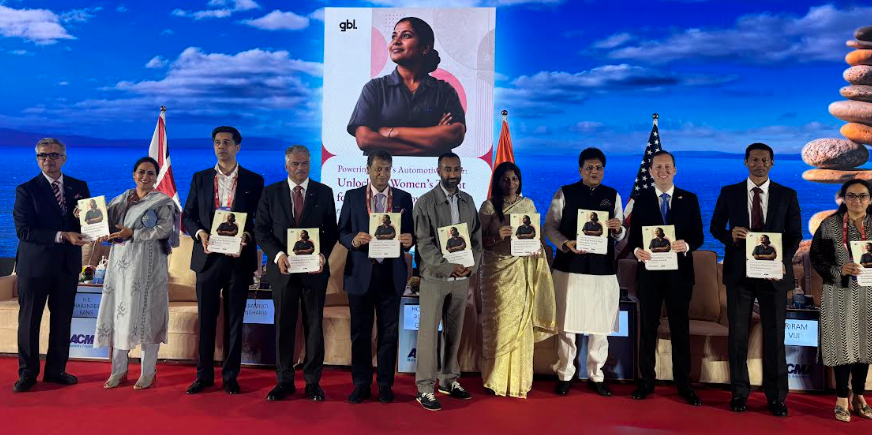
New Delhi, Sep 03: A new report, ‘Powering India’s Automotive Sector: Unlocking Women’s Talent for Industry Growth,’ by Good Business Lab, a non-profit labour innovation and research organisation, was unveiled at the 66th ACMA Annual Session. The report brings together findings from a three-year programme to identify and test practical shopfloor solutions that help firms attract, retain and advance women workers, and what this means for the sector’s growth and global competitiveness. The programme was developed with the support of the Automotive Component Manufacturers Association of India and the Gates Foundation.
India’s automotive industry is entering one of its most ambitious growth phases yet, central to the Viksit Bharat mission to lift manufacturing to 25% of GDP by 2047—with women identified as one of its key pillars. Yet their share of the combined OEM and component manufacturing workforce remains low, rising only from 5.6% in 2023 to 8.7% in 2025.
The economic opportunity extends well beyond the automotive sector. Research estimates that doubling women’s labour-force participation could contribute close to $14 trillion towards India’s $30 trillion GDP ambition by 2047. For automotive manufacturers, greater participation of women represents an opportunity to widen the available talent pool while building a more productive, reliable and resilient workforce. GBL’s research identifies four areas where firms can act:
-
Broaden access to talent through more gender-effective recruitment.Awareness remains a real barrier; only 22–40% of women job seekers that GBL surveyed across NCR and Bengaluru knew that automotive firms hire women. Firms can also boost job appeal by shaping offers around what women value most, such as the option to bring a peer or work with a woman supervisor, without raising wages. An ongoing recruitment trial with 1,200+ women job seekers suggests that these non-wage amenities matter more than expected, improving job acceptance, particularly during periods of strong labour demand.
-
Invest in retention by building workplaces where women can stay and grow. Practical improvements to infrastructure, work environment and access to career-building opportunities can strengthen retention and help firms build a more experienced workforce and a stronger pipeline for future roles.
-
Get more value from the skills firms already invest in.Systematic skills tracking can help firms deploy women workers more effectively and reduce unnecessary retraining, while portable skills records can make it easier to match experienced women to roles that reflect their capabilities.
-
Enable safe access to night shifts to build a more flexible, resilient workforce. Restricting women largely to daytime shifts can constrain both hiring and production flexibility. Enabling women to work safely across shifts can expand the pool of workers available to manufacturers and reduce pressure on individual production shifts. The report identifies transport as a potentially critical enabler of night-shift access for women—with key improvements to existing systems, including shift-based routing, pooled models and greater use of technology.
President, Automotive Component Manufacturers Association of India , noted,
“Women’s participation is no longer a diversity aspiration for India’s automotive industry—it is a workforce imperative. As we scale towards a globally competitive and resilient automotive sector, we must expand our talent pool, create workplaces where women can thrive, and ensure that successful practices move from isolated examples to industry-wide adoption. The future of automotive manufacturing will be stronger when it draws on the full strength of India’s talent. This report provides automotive firms with a practical first step toward translating this imperative into action.”
Archna Vyas, Country Director, Gates Foundation, said,
“As India continues to build on its progress towards a Viksit Bharat, expanding economic opportunities for women will be a core driver. The automotive industry, given its scale and spread, can help create more pathways for women to enter, stay, and contribute to strengthening the manufacturing sector. The Gates Foundation is committed to supporting such efforts that offer potential roadmaps for accelerating these opportunities.”
The report brings these opportunities together into practical tools and approaches that firms can test in their own contexts, drawn from engagement with 55+ OEMs and Tier 1 component manufacturers, 400+ stakeholder interviews, 1,900+ individuals in quantitative research, and an ongoing recruitment trial with 1,200+ women job seekers. Some of them include gender-intentional recruitment, infrastructure-readiness checklists, gender-sensitisation programmes, digital skills tracking, a portable skills passport and shift-based transport models.
Anant Ahuja, co-founder at GBL, noted,
“After three years of speaking directly with hundreds of workers, managers and industry leaders, one thing became clear: the intent to build a more diverse workforce exists, but the challenge is turning that intent into implementation. What was missing was evidence on where to intervene, and proof that these interventions actually work. This report offers a foundation for both.”
As the automotive industry enters its next stage of growth, the opportunity is to make successful practices easier for firms of all sizes to adopt and to learn from one another as they do so. The work now is to make it easier for the next firm to act, the next woman to enter, and the next successful practice to spread—helping build the larger, stronger workforce that India’s Viksit Bharat manufacturing ambitions require, one that draws on the full potential of India’s talent.
These figures were calculated by GBL based on publicly available databases. For more details, please refer to the report.
This recruitment trial is a Randomised Controlled Trial, currently ongoing in the NCR industrial belt, being conducted by GBL. Findings from this trial are forthcoming.