Bhubaneswar, Aug. 7 (UDN): The Odisha government has stepped up efforts to fast-track farmer registration and strengthen digital agriculture services as the State Level Steering Committee (SLSC) for AgriStack reviewed the implementation of the Farmer ID programme and preparations for the Kharif-2026 Digital Crop Survey (DCS).
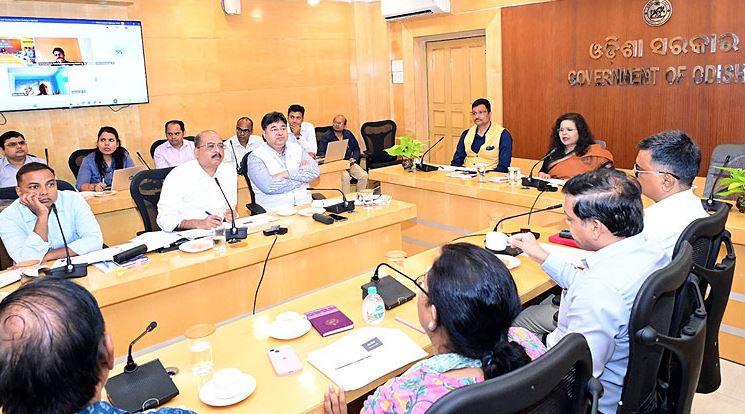
The eighth meeting of the committee, chaired by Chief Secretary Anu Garg at Lok Seva Bhawan, focused on improving the pace of farmer enrolment, ensuring data accuracy and enhancing coordination among departments to support technology-driven agricultural governance.
Senior officials from the Revenue & Disaster Management, Agriculture & Farmers’ Empowerment, Finance, Food Supplies & Consumer Welfare, Cooperation, Fisheries & Animal Resources Development, MSME and Electronics & Information Technology departments participated in the meeting. Representatives from the Union Ministry of Agriculture & Farmers’ Welfare also joined virtually.
AgriStack, a joint initiative of the Centre and state governments, aims to create a comprehensive digital ecosystem for agriculture by assigning every eligible cultivator a unique Farmer ID. The digital identity will enable seamless access to government welfare schemes, crop insurance, institutional credit, input subsidies and personalised agricultural advisory services through a unified platform.
Reviewing the progress, Agriculture & Farmers’ Empowerment Commissioner-cum-Secretary Sachin Ramachandra Yadhav informed the committee that Odisha has targeted the registration of 44.38 lakh farmers across all 30 districts. So far, 20.75 lakh farmers have been enrolled, with Jharsuguda recording the highest registration rate at 75.78 per cent. The state witnessed a significant rise in registrations during 2026, including a record 2.29 lakh enrolments in May alone.
To strengthen implementation, the committee proposed establishing an AgriStack Commissionerate headed by a Director-level officer. A dedicated administrative structure, supported by Revenue, Agriculture and Electronics & IT departments, is expected to improve coordination and monitoring. District-level committees led by Collectors and block-level committees under Tahasildars will oversee field implementation, backed by a state-level Project Management Unit (PMU).
Chief Secretary Garg directed the Revenue, Agriculture and Food Supplies departments to jointly prepare a standard operating procedure (SOP) for identifying genuine farmers, including sharecroppers and cultivators, to ensure a transparent, uniform and time-bound registration process. She also stressed the need for maintaining high-quality data and completing pending approvals within the prescribed timeline.
The committee also reviewed preparations for the Kharif-2026 Digital Crop Survey, scheduled to commence on August 16. The survey, expected to continue for up to two months, will map crop cultivation across the state using GPS-enabled digital tools.
Officials said training of field personnel at district and block levels will be completed between August 5 and August 17. To improve precision, survey data will now be captured within 10 metres of plot boundaries, compared to the earlier 20-metre standard adopted during the Rabi survey.
The upgraded Digital Crop Survey mobile application will feature enhanced artificial intelligence capabilities for real-time identification and verification of both paddy and non-paddy crops. Weekly reviews at the block level and fortnightly monitoring at the district level have also been mandated to ensure smooth execution.
Highlighting the importance of reliable agricultural data, Chief Secretary Garg said the Digital Crop Survey would play a crucial role in crop insurance settlement, production assessment, agricultural planning and evidence-based policymaking.
She said AgriStack has the potential to transform the delivery of agricultural services by making governance more transparent, efficient and farmer-centric through the effective use of digital technology.