Bhubaneswar, July 26 (UDN): India’s ambitious high-speed rail programme has taken another significant step forward with the Mumbai-Ahmedabad Bullet Train project adopting the country’s first-ever high-speed electrification system. While Odisha is not part of the inaugural corridor, the technological breakthrough has sparked hopes that future bullet train networks could one day connect Bhubaneswar to major metros in record time.
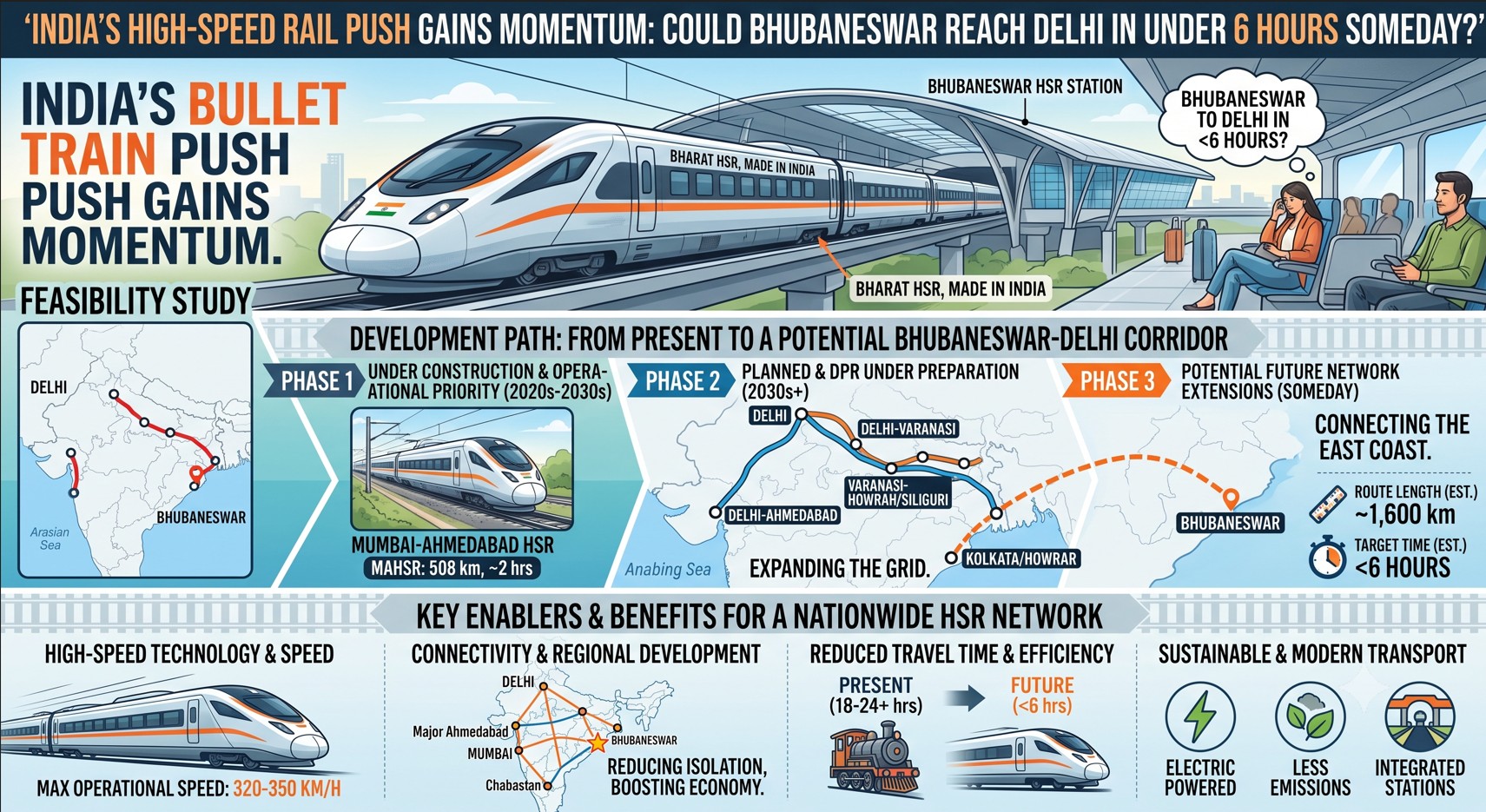
Representational Image
If high-speed rail corridors are eventually extended to eastern India, travel from Bhubaneswar to Delhi could potentially be completed in around six hours, while Bengaluru may be reachable in nearly five hours—dramatically reducing current journey times.
India’s First High-Speed Rail Electrification
The 508-kilometre Mumbai-Ahmedabad High-Speed Rail corridor is being equipped with an advanced 2×25 kV Overhead Traction System, a technology capable of supporting trains operating at speeds of up to 320 kmph.
Unlike conventional railway electrification, the system is designed to deliver a stable and uninterrupted power supply even at extremely high speeds. Electricity will be sourced from the National Power Grid through dedicated grid substations and 14 traction substations spread across Maharashtra and Gujarat.
As trains move between different sections of the corridor, power transfer will occur seamlessly without disrupting operations.
Smart Power Network for Reliable Operations
To ensure uninterrupted services, the corridor will feature 31 switching posts, enabling quick isolation of faults and continuous electricity supply. Additionally, 16 distribution substations are being developed to power railway stations, signalling systems, depots and maintenance facilities.
The project will also install nearly 22,000 steel masts supporting over 1,125 track kilometres of overhead electrical wires, forming the backbone of India’s first high-speed railway electrification network.
Safety at the Core
Safety remains a key focus of the bullet train project. Every traction substation will be equipped with earthquake detection seismometers capable of detecting seismic activity and triggering emergency protocols within seconds. If required, trains can be brought to a halt almost immediately, enhancing passenger safety.
What It Could Mean for Odisha
Although no bullet train corridor has been announced for Odisha, the successful implementation of this technology could serve as a blueprint for future expansion of India’s high-speed rail network.
A future corridor connecting Bhubaneswar with cities such as Delhi, Kolkata, Hyderabad or Bengaluru could significantly reduce travel time, boost trade and tourism, and improve regional connectivity. Faster rail travel would also offer a sustainable alternative to short-haul flights and long-distance road journeys.
A Step Towards India’s High-Speed Future
The Mumbai-Ahmedabad Bullet Train project marks more than just the launch of a new railway line—it represents India’s transition towards world-class high-speed rail infrastructure. While Odisha’s bullet train dream remains on the horizon, the technologies being deployed today could eventually shape tomorrow’s transport landscape across eastern India.
As India’s high-speed rail ambitions expand, states like Odisha may well be among the beneficiaries of the next generation of fast, efficient and safer rail travel.