Carlsbad, California, 8 April 2026: TAU Systems, a pioneer in compact particle accelerator technology, today announced a major scientific milestone: the first-ever demonstration of reliable, continuous operation of a laser-powered accelerator (LPA)-driven free-electron laser (FEL) sustained over more than eight hours without operator intervention. The achievement, published in a new research paper, marks a pivotal step toward making ultra-bright, tunable light sources practical for real-world scientific and industrial applications.
Traditional FEL facilities rely on large, costly radio-frequency accelerators that occupy entire campuses. LPAs shrink the acceleration distance from hundreds of meters to just millimeters by harnessing powerful laser pulses to accelerate electrons in a plasma. While the physics of LPA-driven FELs has been understood for almost 50 years, LPAs have historically had lower beam quality and stability, until now. Translating this technology into a stable light source has remained one of the field’s most stubborn engineering challenges.
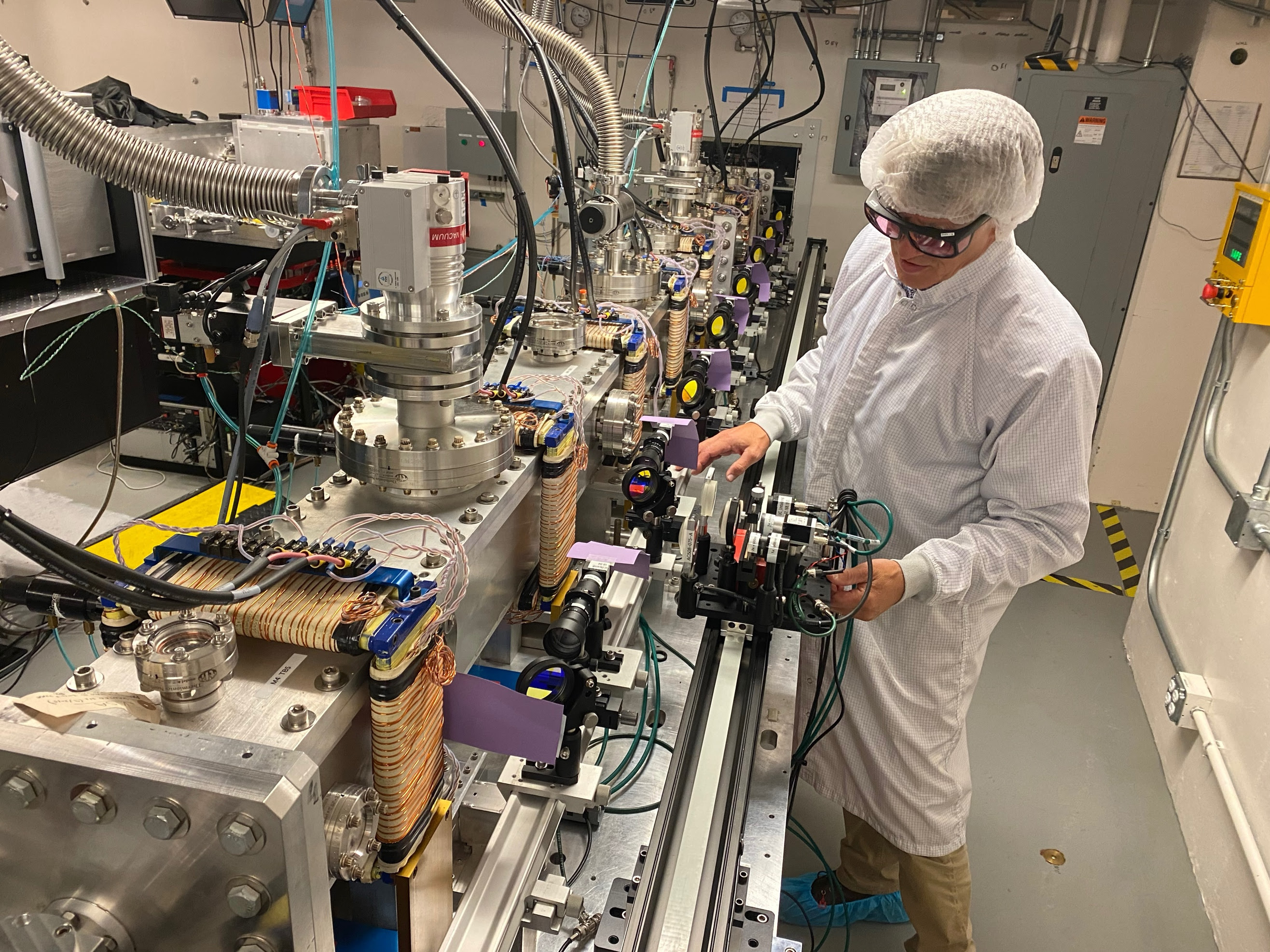
The TAU Systems team, in collaboration with Lawrence Berkeley National Laboratory (Berkeley Lab), achieved this breakthrough by engineering a suite of interlinking stabilisation technologies onto the Hundred Terawatt Undulator (HTU) experiment at Berkeley Lab’s BELLA Center. The result was 100 MeV electron beams delivered at 1 Hz with high consistency over a continuous ten-hour period, driving a self-amplified spontaneous emission (SASE) FEL operating at 420 nm (in the visible blue-ultraviolet range) for more than eight hours without any manual adjustments.
Stephen Milton, VP of Accelerator Science at TAU Systems said: “This is the moment the community has been working toward. We have shown that an LPA-driven FEL is not just a proof-of-concept experiment. It is a platform capable of delivering the stability that real scientific and industrial users demand.”
Beyond simply operating the light source autonomously, the team used the extensive dataset collected during the run to map correlations between the properties of the drive laser, plasma source, and electron beam, and the resulting FEL output. These insights are already informing the next phase of performance improvements, with residual correlations in the data indicating that further gains in stability and brightness are within reach.
“This reported level of reliability and performance of the LPA-driven FEL not only represents a great improvement toward demonstrating the potential for future light source applications,” says Finn Kohrell, a postdoctoral scholar in the BELLA Center at Berkeley Lab and lead author of the published results. “It also allows us to gather an unprecedented amount of data about the highly complex interaction between the LPA and FEL process, and to identify which parameters are most impactful for further improving the FEL performance.”
The implications extend well beyond just one laboratory. Compact LPA-driven light sources have long been envisioned as a way to democratize access to high-brightness X-ray and UV beams, which are currently only available at a handful of national synchrotron and FEL facilities worldwide. Applications include structural biology, materials science, semiconductor lithography, medical imaging, and fundamental physics research. By demonstrating autonomous, multi-hour operation, TAU Systems and Berkeley Lab have cleared a critical barrier on the path to commercially deployable compact FELs.
TAU Systems characterizes the current system as a powerful research platform for the broader LPA-driven FEL community, enabling systematic studies of accelerator-to-light-source coupling that were previously impossible without long-duration stable operation. The company expects the findings to accelerate progress across the field and inform the design of future compact light source installations.
