First Technical Milestones Achieved Alongside Expanded Collaborations with Vietnam and India

NEW YORK, Oct. 1, 2026 /PRNewswire/ — The AI Alliance today announced significant progress for Project Tapestry, combining completion of its first technical milestone with expanded sovereign AI collaborations with Vietnam and India during United Nations General Assembly Week in New York.
Project Tapestry is building an open, global consortium to develop advanced AI, enabling nations and institutions to collaborate on increasingly capable foundation models while retaining control of their data, sovereign models, and deployments.
First Technical Milestone Demonstrates New “Consortium Training” Approach
Project Tapestry recently completed its first major technical milestone, demonstrating key building blocks that let organizations across different countries, infrastructure, and jurisdictions collaboratively train and adapt AI models.
Two proofs of concept coordinated model training across four geographically distributed sites, while keeping the underlying training data local to participating sites. Teams also demonstrated cultural alignment – modifying a large language model to better understand the unique social and linguistic aspects of Indian and Vietnamese cultures.
The milestone provides an initial demonstration of one of Project Tapestry’s central premises: organizations do not need to centralize their compute or data under a single institution in order to collaboratively build increasingly capable AI models.
Vietnam Advances Sovereign AI Collaboration
During UN General Assembly Week, AI Alliance and Project Tapestry leaders met in New York with Vietnam’s General Secretary and senior government ministers to advance collaboration on the development of sovereign AI capabilities for Vietnam.
The discussions affirmed an intention to collaborate on a sovereign AI model aligned with Vietnam’s national AI strategy and priorities, including Vietnamese language, culture, knowledge, and national use cases.
Vietnam has participated in Project Tapestry since its early stages, and the expanded collaboration represents an important step toward translating the consortium model into national-scale sovereign AI development.
“Project Tapestry gives Viet Nam an opportunity to turn international collaboration into lasting national capability—developing AI that understands our language, culture, knowledge, and priorities, while building the engineers and institutions to operate, adapt, and advance the technology,” said Ambassador Hoang Anh Tuan, Consul General of Viet Nam in San Francisco.
“Our meeting with General Secretary and President Tô Lâm, and his strong support for this direction, underscores the broader vision for Tapestry,” said Christopher Nguyen, Chief Architect of Project Tapestry. “Across Viet Nam, India, Japan, Bhutan, and beyond, we are building a model for nations to shape the frontier together while preserving sovereignty over their data and technological future.”
India Expands Its Role in Project Tapestry
During UN General Assembly Week, Consul General Binaya Srikanta Pradhan hosted Project Tapestry leaders at the Consulate General of India in New York. Prof. Ganesh Ramakrishnan of BharatGen, Prof. Ritwik Banerjee of Stony Brook University in the United States, and Kaushik Bhatta, Partner, Director, AI Alliance, briefed the Consul General on consortium-driven AI development, Tapestry’s approach, and Stony Brook’s recent addition to the consortium.
“India is a microcosm of the world. AI built for its languages and cultures preserves agency,” said Pradhan.
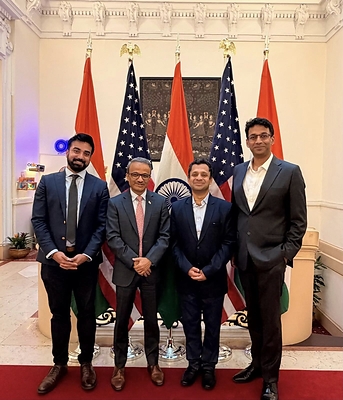
India has been an early contributor to the project. BharatGen, India’s government-backed, open-source foundation model stack, ran one of the two proofs of concept under the guidance of Dr Maneesh Singh, VP Machine Learning, in Tapestry’s first technical milestone, training jointly with Monash University across India and Australia while each institution’s data remained in its home country.
The same week, the Gates Foundation named Prof. Ramakrishnan a 2026 Goalkeepers Champion, recognizing him at Goalkeepers New York for his leadership of BharatGen.
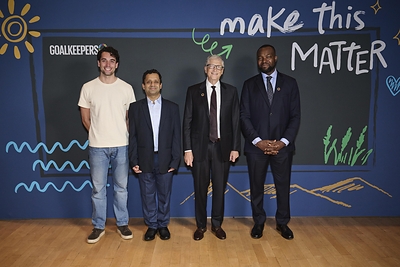
The meeting comes ahead of a Project Tapestry workshop in Mumbai on October 15, hosted by BharatGen, which will bring together technical and institutional leaders to plan the next phases of India’s participation.
From Technical Proof to Global Collaboration
With momentum from its first technical accomplishments and national-scale collaborations, Project Tapestry is moving into its next phase, expanding work in consortium training, cultural alignment, and data governance, with growing participation from countries and institutions worldwide.
Tapestry contributors also presented “Sovereignty Through Interdependence: Epistemic Agency, Intelligent Action, and Federated AI” at the First Workshop on Sovereign AI for Collaborative and Pluralistic AI Ecosystems, co-located with ACM HCOMP 2026 in Washington, D.C., and organized by researchers at Taiwan’s Academia Sinica. The paper, by Dr. Maneesh Singh, Ritwik Banerjee, Lav R. Varshney, and Kaushik Bhatta, examines how federated approaches like Tapestry’s can support AI sovereignty through collaboration.
“Our first milestone and growing global collaborations demonstrate that Tapestry is moving from architecture to working technology,” said Anthony Annunziata, co-founder and chair of the board of the AI Alliance. “Organizations operating across countries and infrastructure have now trained models together while maintaining control of their own data. It is an important first step toward building advanced AI collaboratively, openly, and sovereign by design.”
About Project Tapestry
Project Tapestry is an AI Alliance initiative developing an open consortium approach to building advanced foundation models and sovereign AI systems. Its architecture enables distributed organizations to contribute data, compute, expertise, and model improvements while maintaining control over their underlying data.
About the AI Alliance
The AI Alliance is a global nonprofit research and technology organization dedicated to advancing open, safe, and responsible AI through innovation, collaboration, and advocacy. The Alliance brings together more than 200 organizations across 29 countries spanning industry, academia, startups, research, and government.

 View original content to download multimedia:https://www.prnewswire.com/in/news-releases/project-tapestry-gains-momentum-for-sovereign-ai-during-un-general-assembly-week-302895081.html
